Summary
This article reports new research on how Irish nursing homes are positioned to be visible and well-understood by families who may directly or indirectly use AI such as ChatGPT or Google's AI to find and vet them as they make a decision around choosing a home.
The main body of the article focuses on three areas where homes can make improvements and explains why this is advisable.
The full research findings and results are in the appendix at the foot of the article. The results summary is as follows:
Across 15 Irish nursing homes, the average overall synthesis score was 50.4/100.
AI search visibility was the weakest major area at 33.3/100, including just 3.1/30 for recommendation visibility and 2.3/20 for specialism visibility.
Technical presentation averaged 41.6/100, with particularly low scores for Schema JSON-LD at 3.6/25 and sameAs links at 1.9/20.
Robots.txt access was generally well configured, averaging 19.3/20. Marketing alignment was the strongest area at 86.8/100.
While AI is not yet a tool the majority of families will use to vet homes, the trend clearly indicates growth in that direction. And while converting interest into welcoming a new resident is heavily reliant on personal interactions, AI is already acting as a gatekeeper.
A nursing home's ability to clearly communicate its value to an AI a family uses to vet it matters, and that is highly likely to increase in importance.
Why should nursing homes care about what AI thinks of them?
In a sector such as nursing home care, where medical expertise, empathy and relationship building are the currency of success, asking why nursing home owners should care about what ChatGPT or Google's AI thinks of them seems like a low-priority question.
And it would be, if it weren't for a very clear and growing trend.
More and more Irish buyers are using AI to vet products and services before making a buying decision.
Research from Wolfgang Digital/Amárach (2025) reported that 30% of Irish respondents were using ChatGPT to make a purchasing decision, and that figure is trending up.
This finding is reflected in Europe and North America (Gartner), with a growing number of people using AI to vet buying decisions.
AdWorld research reports 54% of Irish respondents used AI as a research tool and 64% 'said ChatGPT strongly or moderately influenced their final purchase decision'.
But does that have implications for Irish nursing homes and how they attract, inform and ultimately welcome new residents?
Are Irish nursing homes affected by AI visibility?
The short answer is, we don't definitively know (lack of research). But if they are, the impact will probably be medium-low in the immediate future.
That is largely because of how nursing homes convert family interest into a new resident.
This conversion usually begins with personal recommendations and/or location searches. Then there's the time families take to understand what government supports are available. There'll almost certainly be a website visit to see if they like the home. If they like what they see and have heard, they make a call that, hopefully, results in a visit.
Throughout this process, the decision-makers will do their best to carry out due diligence. That may involve Googling the home to see what comes up and/or looking at HIQA reports.
Where does AI fit into this?
Although we don't have the data, we can venture to say that only a minority of these decision-makers are intentionally using AI tools such as ChatGPT to do a deep check.
But most are likely using AI unintentionally.
And this becomes part of how these families see and understand your business.
This is how that happens.
How AI is used to vet your home
Every time a family uses Google to run a web search on nursing homes in their area, it gives them AI results in two places. Let's take a look at both.
This is a search for a Galway nursing home:
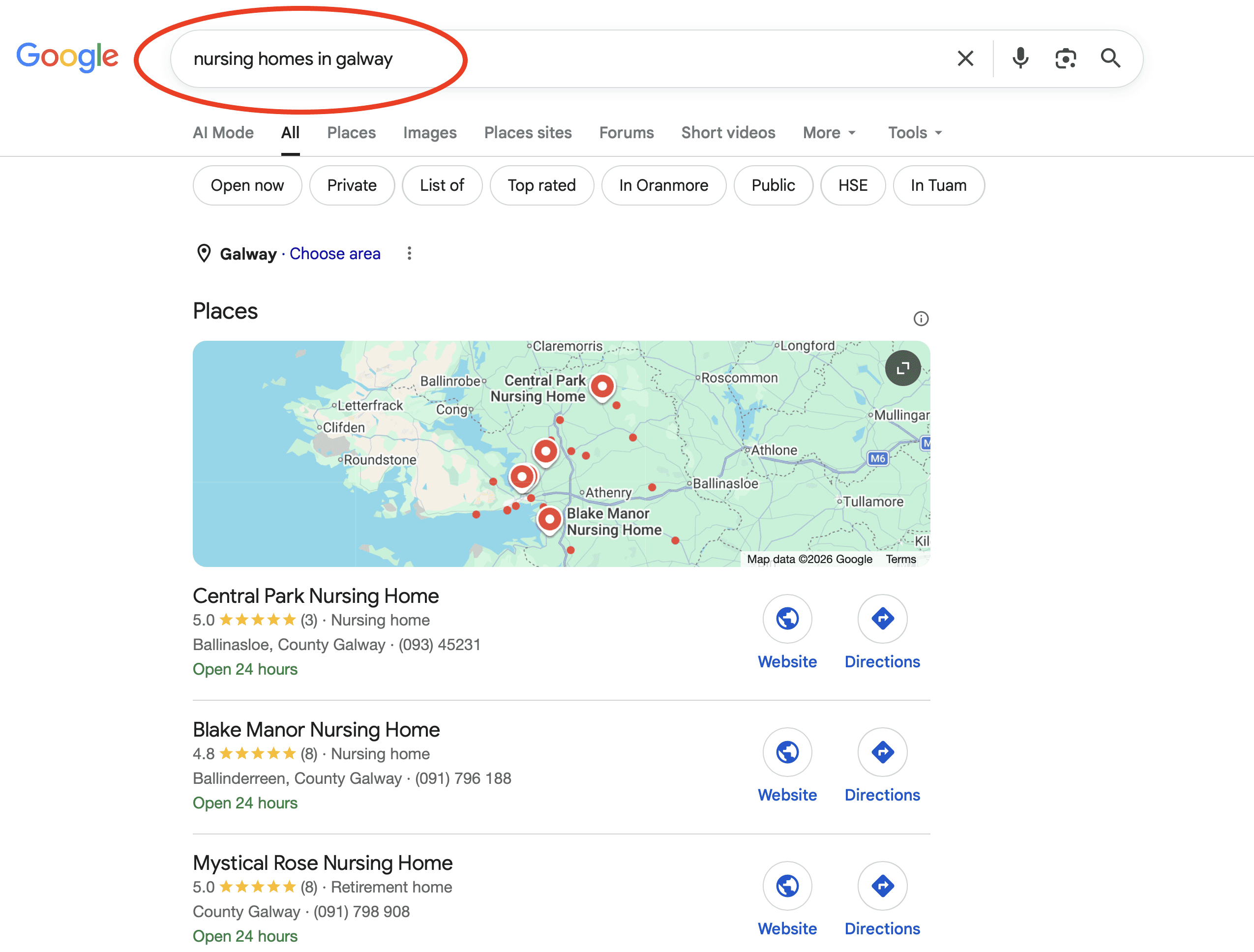
The top of the page is Google Business listings.
But if you scroll down past these, you see this:
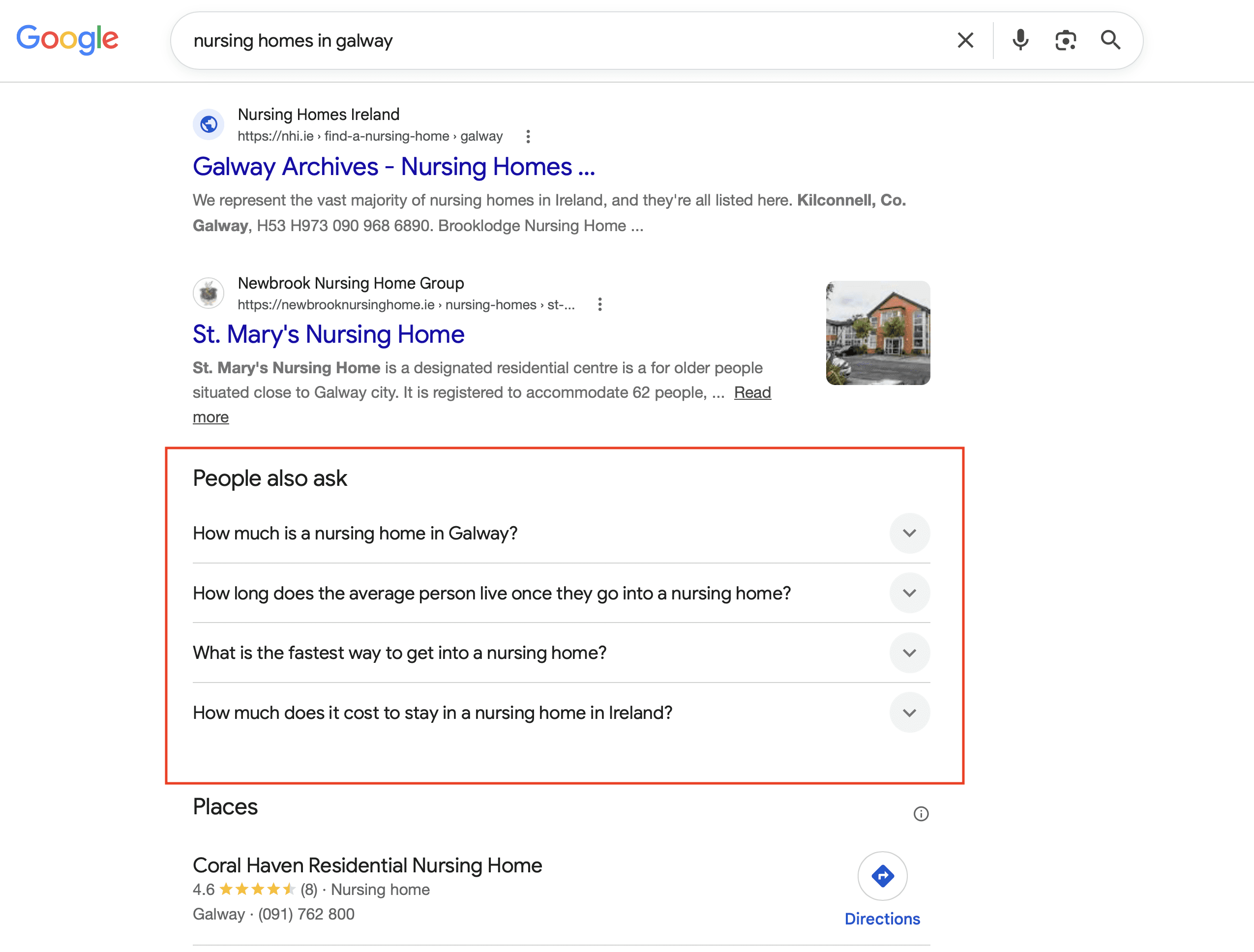
Nestled between traditional Google search results are the 'People also ask' questions.
These are the top questions people ask Google when searching for nursing homes. And they are, in all likelihood, the questions your future residents will ask.
Here's the answer when people click the question about how long people in homes live:
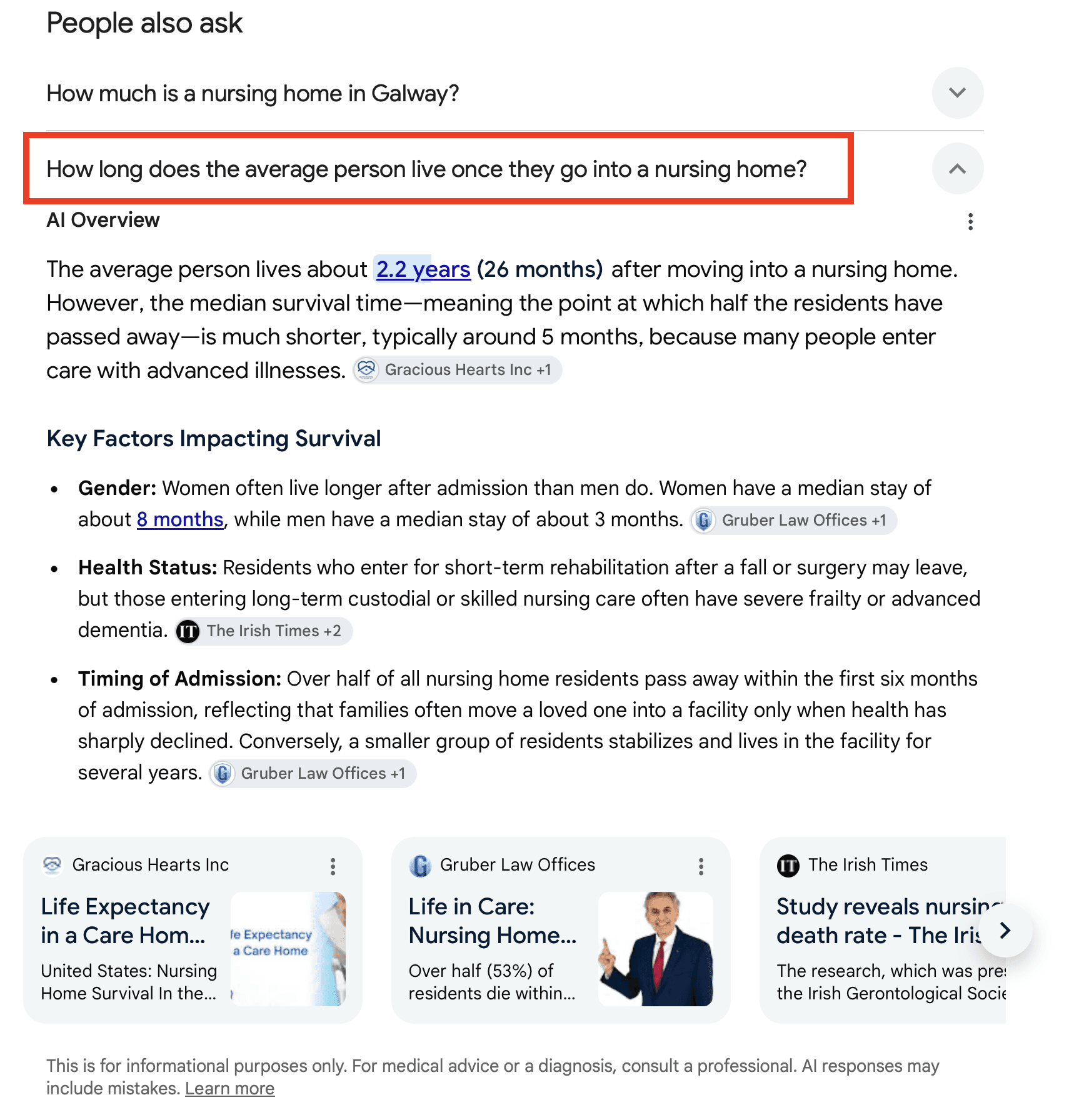
This is an AI-selected answer. And notice that none of the sources for the answer are from Irish nursing homes (more on that later).
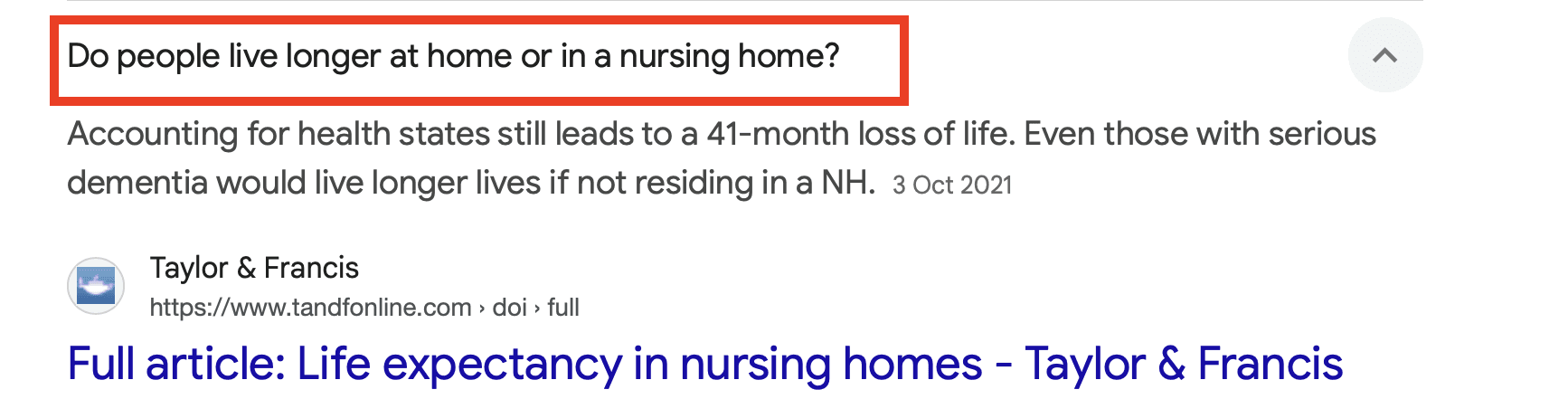
Here's another question and an AI-selected answer. This question might nudge a family to decide not to use a nursing home at all.
These 'People also ask' questions are just one way Google's AI is informing and possibly influencing decision-makers. But they are not the most impactful. That happens at the top left of Google's results page in 'AI Mode'.
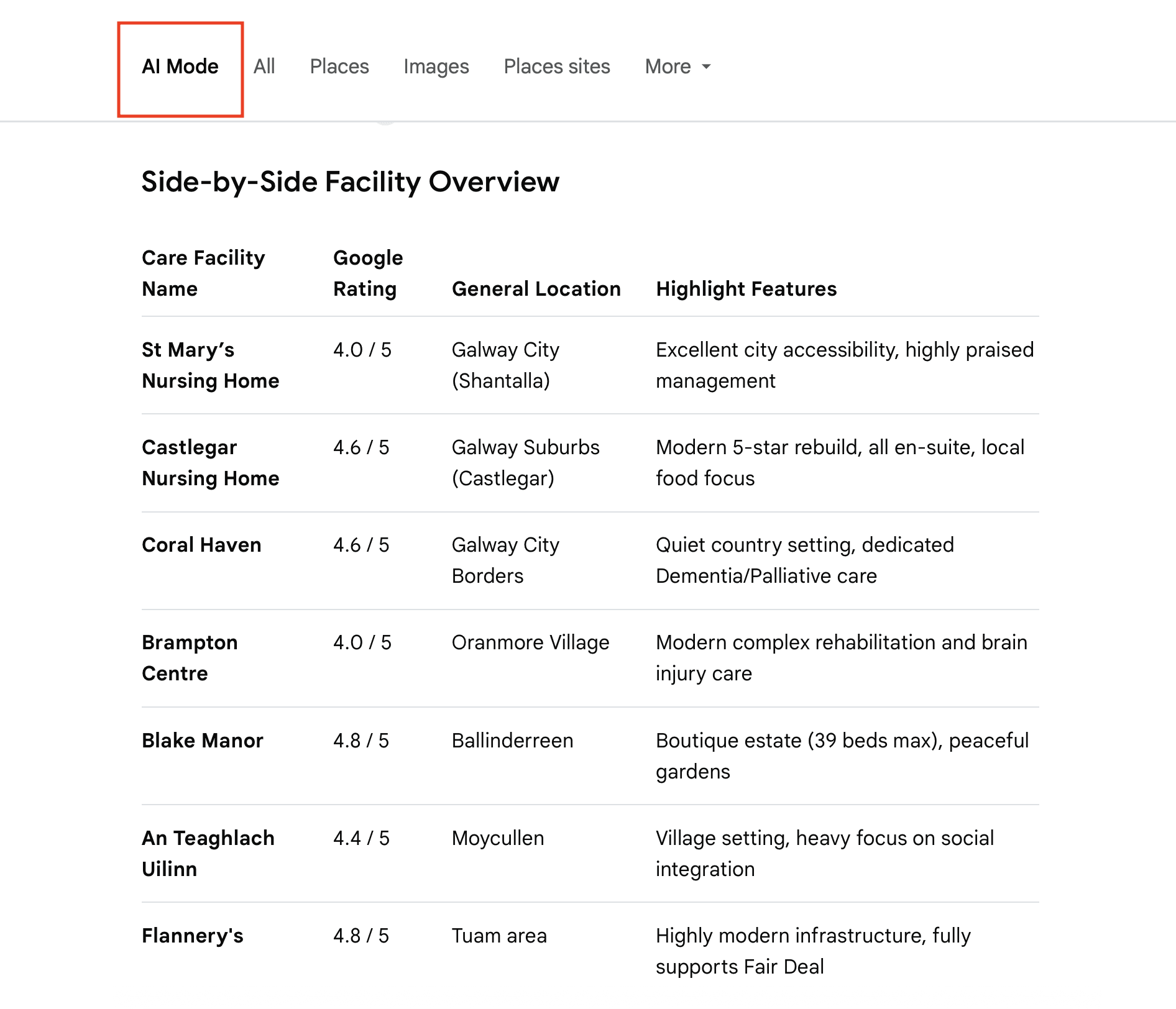
This chart was generated by AI on the Google search page when I clicked AI Mode.
This is AI deciding how to describe your facility and what is worth sharing about you.
And notice that only seven facilities appear. I checked, and AI said it chose those out of 39 available.
This is one of the hard truths about AI.
Unlike Google search results, which will return page after page of listings, AI will only pick what it considers the top candidates.
Everyone else is invisible.
And there's one more way Google's AI can influence decision-makers, and this is perhaps the most powerful.
How Google's AI is used to investigate you
Most of us are at least familiar with how ChatGPT works. You type in a question and you get an answer. After that, you can chat with the AI about that answer or ask more questions.
Google offers the same thing on its search page.
Once you click into AI mode, you are invited to ask it a question. Let's say a family has asked for Galway nursing homes and wants to be more specific. They are looking for a home best suited for someone who has difficulty walking. They might ask this:

Or maybe they want a home for someone who wants to be active in the local community:
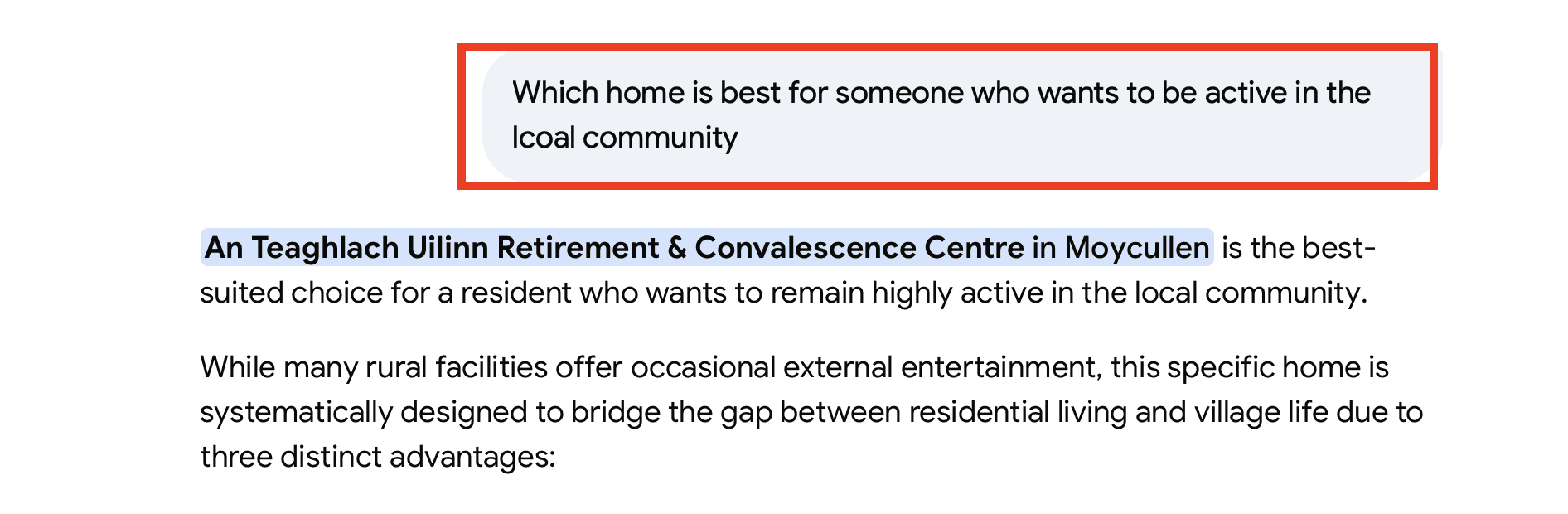
Google's AI is very clear about who it thinks wins each of these categories. For a family looking for a home that best suits their loved one, this becomes a very useful vetting tool.
And using Google's AI is becoming more common. As of 2026, AI overviews are turning up in nearly 55% of Google searches.
The question is, how do nursing homes position themselves so they stand the best chance of being surfaced and recommended by AI? And how well are Irish nursing homes doing this right now?
I researched fifteen nursing homes to find out.
Here are the results and three insights on how to make sure your home improves its AI visibility and is recommended in areas you compete in.
Main Research Findings
Homes audited
I chose 15 nursing homes across Ireland and ran detailed audits on their ability to communicate their value to visiting AI systems such as Google's AI and ChatGPT.
These audits were run using proprietary software, and each produced a report of between 25 and 35 pages.
Ten of these homes were prominent players in the nursing home market in terms of size and online rankings. Some were single-location and some had multiple locations. The bed capacity for these homes ranged from 40 to 180.
Five were mid-tier, with a bed capacity of between 25 and 40 beds.
All 15 were in good standing with HIQA.
I will refer to top-tier homes as T1 homes and mid-tier as T2 homes in this report.
Areas Audited
I looked at five areas where businesses can influence how AI systems see and evaluate them. They are:
Onsite Technical and Information Presentation: this is a mix of invisible data your website carries that AIs can read, and how you present information on your site.
Onsite Expertise, Experience, Authority and Trustworthiness (E-E-A-T): this is how well a website's content establishes credibility in these four areas. E-E-A-T is a framework developed by Google.
Offsite Expertise, Experience, Authority and Trustworthiness (E-E-A-T): this is how you are represented online outside your site. That might be in local papers, industry sites, social media, and anywhere else you are mentioned.
AI Search Results: how well a home does in general and specific searches using AI.
Marketing Alignment Score: how well a nursing home's website content is aligned with how AI systems such as ChatGPT and Gemini see them.
These scores are then weighted for an overall Synthesis Score.
Here's an example score for one of the homes:

Insight 1: Tell AI who you are and what you do
How good are nursing homes at telling AI about who they are and what they do?
You might think that your website content does all that, and yes, that's true, but not in the way you think.
A well-written site can do a great job of communicating to a human reader, but AI, despite all the hype, isn't that good at inferring meaning, and it's kind of lazy.
If it can't easily understand key details, it's prone to giving up and/or just making stuff up. How you write your site and how you explain yourself matters for AI as well as humans.
There are ways to write for both humans and AI at the same time (use answer capsules), but there's something else that works much better.
The solution is a piece of text that is tailor-written for AIs to read, and that's invisible to your human visitors. This is called a JSON-LD.
Here's the top of the Beacon's JSON-LD:
{
"@context": "https://schema.org",
"@graph": [
{
"@type": "WebPage",
"@id": "https://www.beaconhospital.ie/",
"url": "https://www.beaconhospital.ie/",
"name": "Beacon Hospital Dublin - Ireland's Most Advanced Private Hospital",
"isPartOf": {
"@id": "https://www.beaconhospital.ie/#website"
},
"about": {
"@id": "https://www.beaconhospital.ie/#organization"
},
"datePublished": "2020-07-30T01:04:48+00:00",
"dateModified": "2026-08-05T10:09:20+00:00",
"description": "Beacon Hospital has Ireland's most advanced diagnostic equipment & an Emergency Department located in Dublin. HealthCheck, Cardiology,
As you can see, it's not something you'd put in front of a person, but every time the Beacon's website is visited, this text is there for AIs to read. This is called a machine-readable format and it makes it easy for AI to understand.
It's a very clever and efficient way to make sure a visiting AI knows who you are, where you are, what you do, who you help and anything else you want them to know.
How did Irish nursing homes do on using JSON-LDs?
Poorly.
Of the T1 homes, only one had a near-complete and correct JSON-LD.
Another had a near-complete file, but some key details were wrong.
The rest had nothing or generic files.
Of the T2 homes, two had generic files, and three had nothing.
Do you need a JSON-LD?
Strictly speaking, no. But strictly speaking, you don't need a website either. The real question is, should you have one?
Right now, nearly every Irish business gets away without a JSON-LD, but that's because nearly every business website was built when people didn't use AI to research businesses.
That's changing, and it's changing quickly.
You are no longer communicating your value to just people. You are talking to the visiting AIs as well. JSON-LDs are one of the ways your site can do that.
In fact, of all the things I'd recommend a business do to improve AI visibility and how well an AI understands what they do, setting up a quality JSON-LD is top of the list.
It's a bit like insulating the attic of a house as the first and highest-impact decision you can make to improve that house's energy efficiency. Yes, there are lots of other things you could do, such as insulating the walls and getting a heat pump, but bang-for-buck, the attic wins as your first move.
JSON-LD Resource:
https://paulmelrose.com/articles/json-ld-files-how-to-help-ai-understand-your-business
Insight 2: Establishing Expertise, Experience, Authority, and Trust
Expertise, Experience, Authority, and Trust (E-E-A-T) is a framework developed by Google and is a useful proxy for how AI systems make decisions around how they evaluate you.
And you need to make a serious effort to establish that trust. Because AI systems are risk-averse.
If they are asked for a list of suitable nursing homes, and one of the homes they look at doesn't have very clear signals for expertise, experience, authority or trust (E-E-A-T), they are prone to dropping it entirely from their results. We saw that in the Galway nursing home results, only 7 out of nearly 40 were listed.
That has serious implications for a home that may be excellent across all four categories but has failed to communicate that to an AI.
E-E-A-T is established right on the same pages people read. It's how you describe your business, your staff, your experience, and explain why you are experts.
So, how did our fifteen homes do at this?
Thankfully, better than with JSON-LDs, but there is still a lot of room for improvement for most.
Five of the homes, three T1 and two T2, did very well at establishing E-E-A-T on their site.
Seven did okay but with room to improve. These were six T1 and one T2 homes.
Three did poorly: one T1 and two T2.
To be clear, the poor scores are not because these businesses didn't claim expertise. They did. But AI does not believe claims unless they are supported by evidence. Saying, 'We provide the very best in care,' means nothing unless it's backed up.
Here are some of the questions the poorly performing homes failed to answer adequately:
Who is clinically responsible?
What are their qualifications and relevant experience?
What care needs can the home demonstrably manage?
What operating practices support those claims?
What evidence is current and location-specific?
What happens when needs become more complex?
Where can the claims be independently checked?
Your site needs to answer all of that, and more.
Your E-E-A-T Opportunity
Let's return to our Google search for the best home for someone who has trouble walking:
We were recommended a home, but was that the only suitable option in the Galway region?
No.
When I pushed Google, it gave me two more homes.
When I asked why these homes hadn’t been listed originally, it said:
Brampton Care & Rehabilitation Centre was selected due to a high density of specific clinical terms in its data, including "rehabilitation gym," "occupational therapy training kitchen," and "ceiling hoists".
I asked if it was possible that the two other homes it later recommended were just as suitable. And was their site content a factor?
Yes, it is entirely possible that the other two homes are just as good, but Brampton was picked first because it used clearer marketing words. As an AI, I cannot visit these homes to see how well they actually care for people. I can only read the text they put online. Brampton was chosen first because of how it sets up its data.
And here's the important bit:
In the real world, [these other homes] might actually be the better choice for your specific needs. Brampton simply won the first round because its online writing was easier for a computer to read and score.
These two other homes have excellent facilities, but the details were buried. One was 'tucked away under a unique name instead of being on the front page', and the other was 'hidden inside long government inspection papers'.
The home that won this AI recommendation race certainly has the expertise, but it also presented that expertise in a way the other homes did not. That's what made the difference.
The site that does the better job at communicating with AI wins the AI recommendation.
Your website needs to communicate every drop of expertise, experience, authority and trustworthiness it has, across all your staff, facilities and services.
Here's another opportunity.
If we return to the question of how long residents live in a nursing home, we saw there were no Irish nursing homes cited in the results.
That's a problem because that 2.2 years figure is not true for Ireland.
Because this was a question in Google's 'People also ask' section, we know this is something families want to know. You can write the answer.
Publish a helpful article written for families on how long different types of residents typically stay and explain why. That way they get better information, and you are seen as an expert.
E-E-A-T Resource and Advice:
When writing content for your site, aim to include information that is new or unique to you. This is called Information Gain and goes a long way with AI and will make it more likely Google will cite you:
https://paulmelrose.com/articles/how-information-gain-gives-ai-a-reason-to-recommend-your-business
Insight 3: What Others Say Matters
I said above that AI is risk-averse and that claims on your site hold little sway unless proved.
That's because AI treats self-published content as unverified. If they read bold claims such as "industry-leading" or "best in class", they see it as self-puffery.
You can, and should, validate all claims on your site, but the gold standard for AIs is third-party endorsements.
That might be a professional accreditation, a press write-up, publishing an article in a trade magazine, or a professional recognition award. For nursing homes, it also includes HIQA reports.
AI will look at all of these as evidence that independent experts vouch for your credibility.
So, how did our fifteen homes do when it came to third-party support?
Four T1 homes did well, with validating external sources such as HIQA, NHI, university affiliations, national and sector press and award recognition.
Four T1 homes have mixed levels of support.
One T1 home has sparse third-party validation, and one had adverse external coverage.
For T2 homes, two had good third-party validation, one was mixed, one was sparse, and one was adverse.
Out of all fifteen, only 6 had a clearly supportive body of independent evidence. For the rest, expert validation was narrow, difficult to attribute properly or simply adverse.
Your Third-Party Opportunity
What others say about your home matters. It matters even more if those voices are seen by AI as high-trust sources.
Here's a breakdown of third-party validation across all fifteen homes:
Validation source | What it validates |
|---|---|
HIQA | Registration, capacity, provider identity, inspection findings and regulatory compliance |
Nursing Homes Ireland | Sector membership and category confirmation |
NTPF/HSE | Fair Deal participation, approved pricing or placement information |
Universities and clinical partners | Specific professional or academic relationships |
CARF International | Independent service-quality accreditation |
Excellence Ireland Quality Association/Q Mark | Independently assessed organisational standards |
Great Place to Work | Independently administered workplace certification |
Irish Healthcare Centre Awards/NHI Care Awards | Sector recognition of facilities, teams or employees |
Fit Out Awards | Independent recognition of healthcare premises and design |
Building and Architect of the Year Awards | Independent building/design recognition |
National press | Ownership, investment, expansion, incidents and public reputation |
Regional press | Community activity and local reputation |
Sector publications | Healthcare-specific projects, appointments or recognition |
Google reviews | Family, visitor or public experience, subject to volume and authenticity |
Indeed and similar employer sites | Employee experience |
Companies Registration Office | Legal identity, company status and registered details |
Company-information platforms | Secondary confirmation of company identity |
Google Maps/business listings | Location, contact details, reviews and local entity identity |
Sector directories | Basic category, location and contact confirmation |
General directories | Basic name, address and telephone corroboration |
Wikipedia | Organisation history and entity context |
All of these matter, some more than others. Nevertheless, these are all concrete examples of places where AI systems found third-party validation for our 15 nursing homes.
They also offer you a list of places where your home can gain external validation.
Takeaways
At the start of this article, I said I believed the impact of AI visibility on Irish nursing homes was medium-to-low. But I also believe that is changing.
A few years ago, AI was not something the average business had to think about.
But since ChatGPT launched in November 2022, that's changed.
The use of AI as a tool to make financial decisions is growing. It's reasonable to assume this will include how families will make decisions around nursing-home care.
The conversion journey that takes a family from first encounter to choosing your nursing home will always be dominated by the visit to the home and the personal interactions the family have with the owners and staff there.
But these families will also carry out their due diligence. And that may well happen before booking that first visit. That would place AI as a potential and powerful gatekeeper.
Accommodating AI is not a magic bullet. Your home's quality and your ability to communicate that quality are what matter. That's what effective marketing is: communicating your full value to the right people.
What AI has changed is who you are talking to.
As well as prospective residents and other decision-makers, you now need to communicate your value to the AI systems that will be used to vet you.
Not doing that is hiding reasons to choose you.
So, where do you begin?
How to improve your chances of being recommended by AI
Start small.
Put a well-written JSON-LD on your site (you can do that yourself if you spend a bit of time researching it, or get professional help).
It's a quick fix, and I'd put it at the top of my list any day.
Next, make a list of all your key, accredited staff and list them with those accreditations on your site. Do the same for any professional associations, etc.
If you offer something special, list it and explain why it's so valuable.
Talk to your residents. Ask them what makes life with you special. Then talk about that on your site.
Publish at least three expert articles on how you care for people.
Explain your processes and protocols.
If you offer onsite physiotherapy, write an article on why that matters and the benefits of having that available on site. If you offer residents a kitchen to cook their own meals, talk about that.
Look for opportunities for local and national media coverage.
And above all, write in a way that helps non-healthcare professionals understand the depth and expertise of what you do.
As I said, effective marketing is just letting the right people know just how good you are at what you do. And now it's letting AI know that too.
Resources, Sources and Full Results
Further Resources:
If you'd like a professional assessment of your home's current AI visibility, click here:
https://paulmelrose.com/ai
If you'd like to chat about your home's website, reach out here: https://paulmelrose.com/contact
How to increase your perceived value: https://paulmelrose.com/articles/value-prisms
How Google and other AIs understand who you are: https://paulmelrose.com/articles/a-guide-to-business-entities-for-irish-businesses
A framework to self-assess your website: https://paulmelrose.com/articles/six-decisions-that-make-your-website-perform-better
Sources:
https://www.wolfgangdigital.com/blog/why-retailers-shouldnt-ignore-chatgpt-this-golden-quarter/
https://heroicrankings.com/seo/managed/google-ai-overview-statistics-2026/
Appendix: Aggregate Audit Results
Below are the average scores of all fifteen homes. There are five categories, each with sub-scores.
I've excluded one category, Marketing Alignment, from the sub-score breakdowns. The overall score for Marketing Alignment was a very healthy 86.8.
The synthesis score is a weighted average.
There is a short explanatory note below each section.
I used proprietary software to audit these homes. There is a description of that software below the results charts.
Audit dates: 7–10 August 2026.
Results are a snapshot and may change.
AI answers vary by model, location, prompt and date.
The sample was purposive, not statistically representative of all Irish nursing homes.
The scoring framework is proprietary and has not been independently validated.
Overall Score Averages
Stage | Average score | Max |
|---|---|---|
On-site technical and information presentation | 41.6 | 100 |
On-site E-E-A-T | 54.9 | 100 |
Off-site E-E-A-T | 60.3 | 100 |
AI search results | 33.3 | 100 |
Synthesis | 50.4 | 100 |
Marketing alignment | 86.8 | 100 |
Overall, we see a reasonable score for website content and how homes are validated through the digital footprint, indicating third-party validation.
The weakness is in how their sites are set up to communicate clearly with visiting AIs (Technical GEO) and how AIs currently rank them when asked (AI visibility).
The highest score is message alignment, and that's a measure of how well homes do when their website claims are matched against what others and AIs say about them.
On-site technical and information presentation (stage average: 41.6 / 100)
Component | Average score | Max |
|---|---|---|
Robots.txt | 19.3 | 20 |
llms.txt | 0.2 | 5 |
Schema JSON-LD | 3.6 | 25 |
sameAs links | 1.9 | 20 |
Meta tags | 7.9 | 15 |
Heading structure | 3.7 | 10 |
SSR signals | 5.0 | 5 |
The one score nursing-home owners can ignore here is llms.txt. That's not a commonly used tool, but I did include it because it is useful for tracking trends across multiple audits. It's a nice-to-have, but very low on any list of changes.
What owners should focus on, or rather their marketing people, are JSON-LD and sameAs links. SameAs links are how you tell an AI who you are elsewhere online. Both of these help define who you are both on your site and off.
Improving your technical scores is usually the easiest and quickest way to make your business more AI-visible and recommendable.
On-site E-E-A-T (stage average: 54.9 / 100)
Component | Average score | Max |
|---|---|---|
Answer capsules | 5.9 | 25 |
Information gain | 12.5 | 25 |
Entity clarity | 17.2 | 20 |
Content extractability | 12.9 | 15 |
Heading structure | 3.3 | 10 |
AI slop signals | 3.1 | 5 |
The areas where homes did well are in explaining who they are and making it easy for AIs to extract data.
But they scored poorly on answer capsules and AI slop signals.
Answer capsules are a question-and-answer format that AIs like when they are looking for answers users have asked. Improving that would also improve content extractability.
The AI slop score is a measure of what AI see as unsubstantiated grandiose claims.
Off-site E-E-A-T (stage average: 60.3 / 100)
Component | Average score | Max |
|---|---|---|
Off-site E-E-A-T corroboration | 16.0 | 25 |
Online presence breadth | 11.2 | 20 |
Source authority weight | 11.1 | 20 |
Accuracy | 11.9 | 20 |
Consistency | 10.1 | 15 |
The digital footprint score is how well a home does when it is talked about on third-party sites.
Overall, these scores are a good starting point. I've seen a lot worse. Part of that is because nursing homes are highly regulated and a good HIQA report goes a long way.
The opportunities for improvement include local and national press coverage and having articles published.
AI search results (stage average: 33.3 / 100)
Component | Average score | Max |
|---|---|---|
Recommendation visibility | 3.1 | 30 |
Evaluation response quality | 9.5 | 25 |
Specialism visibility | 2.3 | 20 |
Unprompted footprint accuracy | 10.5 | 15 |
Cross-model consistency | 7.9 | 10 |
AI visibility was measured on ChatGPT, Claude and Google's Gemini.
Each home was assessed with five questions. Here's a sample:
Who are the best nursing homes in Tipperary, Ireland? (recommendation question)
I need a nursing home that specialises in residential care for elderly patients in Tipperary (problem question)
What are my options for nursing home care in Tipperary? (comparison question)
Which nursing homes in Tipperary are most recommended and trusted? (trust question)
I need you to check out NURSING HOME for me as a possible nursing home provider
The 'Recommendation visibility score' of 3 looks very low, and that's a reflection of the reality of AI recommendations. When you ask AI for a recommendation, it may pick one or two options out of dozens.
The other big gap is the 'Specialism visibility' score.
This tells us that the majority of homes do a poor job of communicating specialities AI users may look for. It helps explain why in the example in the main article, only one home was surfaced when asked for a home suitable for people with difficulty walking.
The good news is that most homes score well when AI is asked specifically about them.
Audit Software
I wrote the software to audit these homes using Claude Code. This was not a vibe-coding project.
Here is Claude's explanation of the software and the approach we took to scoring:
How the GEO Audit Tool was designed
The GEO Audit Tool was built from first principles during a structured design phase in early 2026. Before any code was written, seven best practice context documents were researched and authored, each covering a discrete domain of AI visibility. These documents — covering technical GEO standards, content extractability, E-E-A-T framework application, entity consistency, legacy noise, online presence standards, and AI evaluation criteria — serve as the analytical foundation the tool's AI auditor works from. They are living documents, reviewed and updated as research and AI model behaviour evolve.
Research foundations
The tool's methodology draws on emerging GEO research and observed AI model behaviour rather than traditional SEO metrics. Key research inputs include:
Answer capsule and citation pattern research
Information gain research
E-E-A-T as applied to AI
Entity consistency and the Triangle of Trust
Earned media weighting
llms.txt adoption data
AI models used in assessment
The tool uses Claude Sonnet 4.5 (Anthropic) as its primary analytical engine, processing website content, digital footprint data, and query responses against the best practice context documents. Claude Haiku 4.5 handles lightweight classification tasks. In the AI visibility stage, three models are tested directly — Claude (knowledge base query), Google Gemini (live web search), and OpenAI ChatGPT (live web search) — to measure whether and how consistently an entity is surfaced across different AI systems with different training data and retrieval architectures.
How score weightings were established
Each stage is scored out of 100, with points distributed across weighted sub-components. Weightings were not assigned arbitrarily — they were established through iterative testing against observed AI model behaviour during the design phase.
The process: each candidate signal was tested across multiple businesses to assess whether its presence or absence consistently correlated with whether that business was surfaced, recommended, or accurately described by AI models in controlled queries. Signals that showed strong, repeatable correlation with AI visibility outcomes received higher weighting. Signals that functioned as hygiene factors — expected to be present but not sufficient alone to drive visibility — received lower weighting.
For example, recommendation visibility carries 30 of 100 points within the AI visibility stage because it directly measures the commercially relevant outcome: does the business appear when someone asks an AI model for a recommendation? By contrast, SSR signals carry 5 of 5 points within Technical GEO — nearly every modern website is server-side rendered, so its presence is a baseline expectation rather than a differentiator.
Point totals are calculated deterministically from recorded flags and rubric classifications. Some classifications are produced through LLM analysis against fixed criteria, so the resulting measurements should be treated as structured assessments rather than wholly objective observations.
If you'd like to see an example of a full audit's output, there are some screenshots here, about halfway down the page: https://paulmelrose.com/ai
Details
Category
GEO
Reading
10 minutes main article
Author

Paul Melrose
Copywriter
Paul Melrose is a Dublin-based, Irish copywriter and Generative-Engine-Optimisation specialist.
More articles